
Introduction
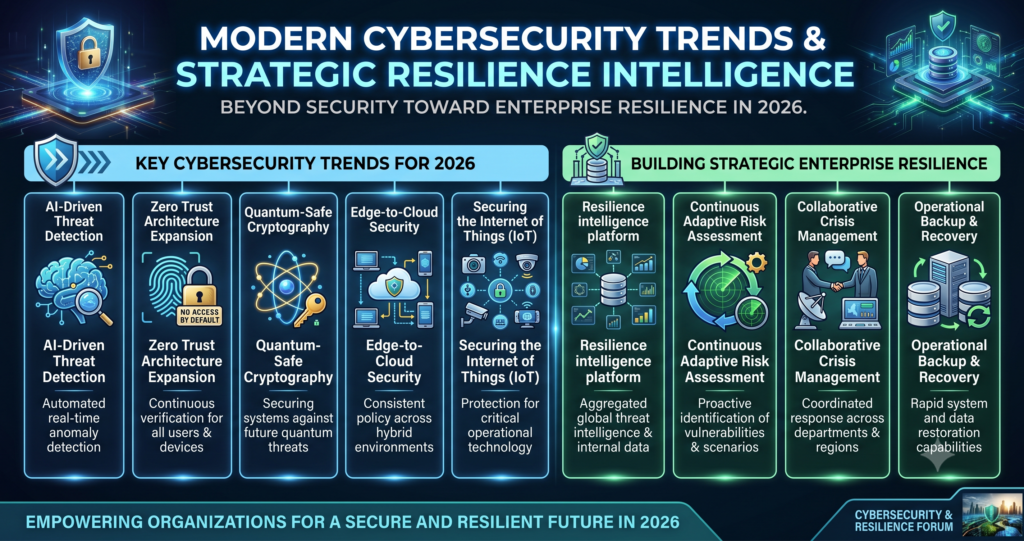
The cybersecurity landscape has undergone a fundamental transformation. What was once viewed as a technology function focused primarily on perimeter defense has evolved into a strategic business discipline that directly influences organizational resilience, operational continuity, investor confidence, regulatory compliance, and long-term competitive advantage.
In 2026, organizations are no longer asking whether a cyberattack will occur. The question has shifted toward how effectively an organization can anticipate, withstand, respond to, and recover from increasingly sophisticated digital threats. This shift has elevated Cybersecurity Resilience Intelligence from an emerging concept to a strategic imperative for enterprise leaders worldwide.
Cybersecurity Resilience Intelligence combines cybersecurity, threat intelligence, business continuity, operational resilience, and executive decision-making into a unified framework that helps organizations navigate uncertainty. As attack surfaces expand across cloud ecosystems, AI-powered applications, third-party supply chains, hybrid work environments, and connected devices, organizations are adopting Cybersecurity Resilience Intelligence to maintain business continuity while accelerating innovation.
Today, Cybersecurity Resilience Intelligence is no longer simply about preventing cyberattacks. It is about ensuring that organizations can sustain critical operations, protect stakeholder trust, and recover rapidly when disruptions occur. This article explores the most influential cybersecurity trends shaping the modern threat environment and explains why Cybersecurity Resilience Intelligence is becoming the foundation of sustainable digital transformation.
Table of Contents
Do Checkout: https://attack.mitre.org?utm_source=chatgpt.com
1. The New Cybersecurity Reality: From Protection to Resilience
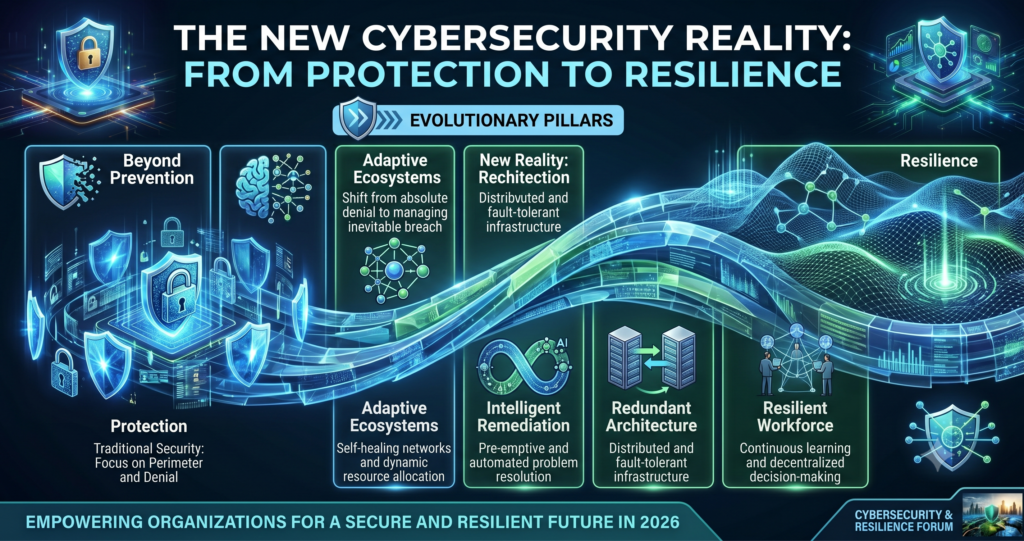
Traditional cybersecurity models were built around prevention. Organizations invested heavily in firewalls, intrusion detection systems, antivirus software, and network segmentation under the assumption that strong defenses could keep attackers out.
That assumption is no longer valid.
Today’s threat actors operate with unprecedented sophistication:
- Nation-state cyber units
- Organized cybercrime syndicates
- Ransomware-as-a-Service operators
- AI-enhanced attack groups
- Insider threats
- Supply-chain infiltrators
Modern enterprises face attacks that bypass conventional security controls through identity compromise, cloud misconfigurations, social engineering, credential theft, and third-party vulnerabilities.
As a result, cybersecurity maturity is no longer measured by the absence of incidents. Instead, organizations are evaluated by their ability to maintain critical operations despite disruption. This principle forms the foundation of Cybersecurity Resilience Intelligence, which focuses on business continuity as much as threat prevention.
Organizations embracing Cybersecurity Resilience Intelligence recognize that resilience is a competitive advantage. The ability to absorb shocks, adapt quickly, and recover efficiently can determine market leadership in an increasingly volatile digital economy.
2. Cybersecurity Resilience Intelligence: A New Operating Model
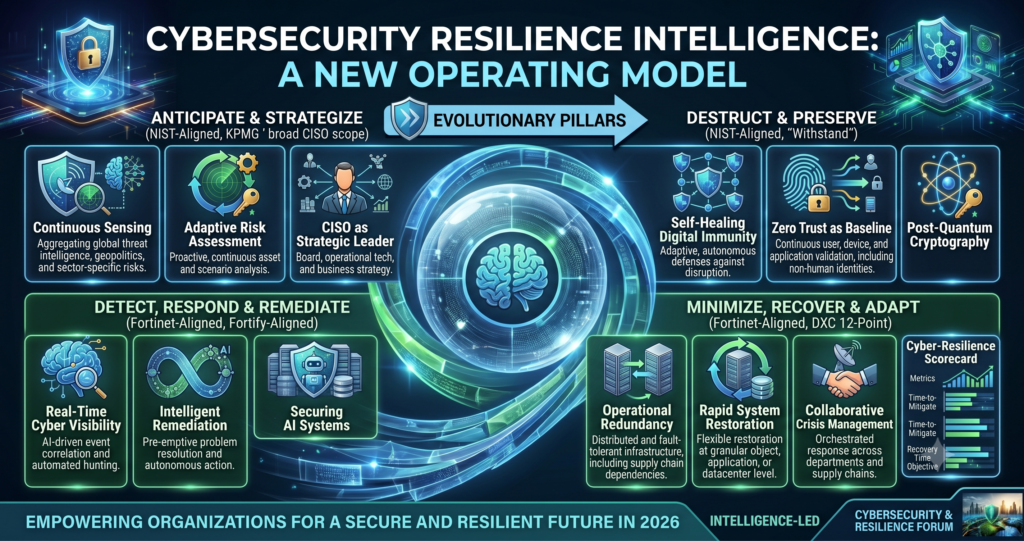
Cybersecurity Resilience Intelligence integrates security intelligence, business risk analysis, operational continuity, and adaptive response mechanisms into a unified operating model.
Rather than asking:
“How do we stop every attack?”
Organizations now ask:
“How do we sustain business operations regardless of attack success?”
This strategic shift defines Cybersecurity Resilience Intelligence and reflects the realities of modern cyber risk.
The framework focuses on five core pillars:
Predictive Intelligence
Leveraging internal and external intelligence sources to anticipate emerging threats before they impact operations.
Adaptive Security
Continuously adjusting defenses based on evolving threat conditions and business priorities.
Operational Resilience
Maintaining business-critical functions during cyber disruptions and system failures.
Recovery Optimization
Accelerating the restoration of systems, services, customer experiences, and operational workflows.
Continuous Learning
Transforming every incident into actionable insights that strengthen future security capabilities.
Organizations implementing Cybersecurity Resilience Intelligence often report stronger operational continuity, lower recovery costs, improved stakeholder confidence, and greater executive visibility into cyber risk.
Trend #1: AI-Powered Cybersecurity Becomes Mission-Critical
Artificial Intelligence has emerged as both the greatest cybersecurity opportunity and one of its most disruptive challenges.
Modern Security Operations Centers (SOCs) process millions of security events daily. Human analysts alone cannot manage this scale effectively.
AI-powered security systems now perform:
- Behavioral analytics
- Threat detection
- Anomaly identification
- Malware classification
- Attack path prediction
- Automated incident triage
- Security orchestration
Advanced machine learning models continuously learn normal organizational behavior and identify subtle deviations that indicate compromise.
AI has become a foundational component of Cybersecurity Resilience Intelligence because it enables organizations to detect threats earlier, respond faster, and reduce operational risk.
The Rise of Adversarial AI
While defenders leverage AI for protection, attackers use the same technologies for offensive purposes.
Emerging threats include:
- AI-generated phishing campaigns
- Deepfake impersonation attacks
- Automated vulnerability discovery
- Intelligent malware adaptation
- Synthetic identity fraud
Organizations pursuing Cybersecurity Resilience Intelligence must therefore invest in AI-enabled defense mechanisms capable of matching attacker speed and sophistication.
The future belongs to enterprises operating machine-speed cybersecurity environments powered by advanced intelligence capabilities.
Trend #2: Zero Trust Evolves Into Enterprise Trust Architecture
Zero Trust has matured beyond an access control framework into a foundational enterprise security architecture.
The guiding principle remains:
Never Trust. Always Verify.
Modern implementations extend verification beyond users to include:
- Devices
- Applications
- APIs
- Cloud workloads
- Machine identities
- Third-party integrations
Organizations increasingly deploy:
Continuous Authentication
Identity verification occurs throughout a session rather than only at login.
Risk-Based Access Controls
Access decisions dynamically adapt according to risk signals.
Micro-Segmentation
Network resources are compartmentalized to prevent lateral movement.
Identity-Centric Security
Identity becomes the primary security perimeter.
Zero Trust significantly strengthens Cybersecurity Resilience Intelligence by reducing identity-based risks and limiting the impact of successful breaches.
As enterprises become increasingly decentralized, Zero Trust serves as a critical enabler of Cybersecurity Resilience Intelligence across distributed digital ecosystems.
Trend #3: Cyber Resilience Becomes a Board-Level KPI
Historically, cybersecurity metrics focused on technical performance:
- Vulnerabilities patched
- Firewall events
- Malware detections
Executive leadership now requires metrics aligned with business outcomes.
Modern boards monitor:
- Mean Time to Detect (MTTD)
- Mean Time to Respond (MTTR)
- Operational downtime
- Recovery effectiveness
- Third-party exposure
- Revenue-at-risk scenarios
Boardrooms increasingly rely on Cybersecurity Resilience Intelligence metrics to understand how cyber risk affects business performance, customer trust, and long-term growth.
Cyber resilience has become a strategic governance priority. Investors, regulators, and customers increasingly evaluate organizations based on their ability to manage digital risk effectively.
In this environment, Cybersecurity Resilience Intelligence has become an essential component of enterprise value creation.
Trend #4: Threat Intelligence Becomes Predictive Rather Than Reactive
Traditional threat intelligence focused on collecting indicators of compromise after attacks occurred.
Modern threat intelligence platforms provide predictive capabilities through:
Geopolitical Intelligence
Understanding nation-state cyber activity and regional threat developments.
Industry-Specific Intelligence
Tracking sector-targeted attack campaigns.
Dark Web Monitoring
Identifying stolen credentials and emerging criminal activity.
Attack Surface Intelligence
Discovering exposed assets before adversaries exploit them.
Threat Modeling
Forecasting potential attack paths and business impacts.
Predictive threat intelligence is a cornerstone of Cybersecurity Resilience Intelligence because it enables organizations to proactively reduce exposure before incidents materialize.
Organizations that operationalize threat intelligence as part of their Cybersecurity Resilience Intelligence strategy gain a significant competitive advantage.
Trend #5: Cloud-Native Security Takes Center Stage
The enterprise perimeter has effectively disappeared.
Organizations now operate across:
- Multi-cloud environments
- Hybrid infrastructures
- SaaS ecosystems
- Containerized applications
- Serverless architectures
Traditional security tools struggle to provide visibility across these environments.
Modern cloud security strategies focus on:
Cloud Security Posture Management (CSPM)
Identifying configuration risks continuously.
Cloud Workload Protection Platforms (CWPP)
Securing workloads regardless of deployment location.
Cloud-Native Application Protection Platforms (CNAPP)
Providing unified visibility across cloud ecosystems.
Runtime Threat Detection
Monitoring active workloads for malicious behavior.
Cloud-native security significantly strengthens Cybersecurity Resilience Intelligence by providing visibility and protection across increasingly complex digital environments.
For many enterprises, cloud security now represents a core pillar of Cybersecurity Resilience Intelligence initiatives.
Trend #6: Supply Chain Cybersecurity Emerges as a Strategic Risk Domain
Third-party relationships have become one of the most significant sources of organizational cyber exposure.
Recent high-profile breaches demonstrate how attackers exploit trusted vendors to infiltrate hundreds or thousands of organizations simultaneously.
Modern supply-chain security requires:
- Vendor security assessments
- Continuous third-party monitoring
- Software Bill of Materials (SBOM)
- Vendor resilience scoring
- Fourth-party risk visibility
- Contractual security obligations
Supply chain governance has become an essential component of Cybersecurity Resilience Intelligence because organizational security now extends beyond internal systems.
Organizations must expand their security boundaries to encompass their entire digital ecosystem if they hope to achieve true Cybersecurity Resilience Intelligence.
Trend #7: Cybersecurity Mesh Architecture Gains Enterprise Adoption
Security environments have become increasingly fragmented.
Organizations deploy dozens of security solutions across multiple environments, often creating operational silos.
Cybersecurity Mesh Architecture (CSMA) addresses this challenge by enabling:
- Shared intelligence
- Centralized visibility
- Unified policy enforcement
- Cross-platform integrations
- Distributed security controls
Cybersecurity Mesh Architecture enhances Cybersecurity Resilience Intelligence by creating a unified security ecosystem capable of supporting distributed operations.
The result is a flexible framework that improves visibility, accelerates response, and strengthens overall Cybersecurity Resilience Intelligence maturity.
3. Cybersecurity Resilience Intelligence Framework for Enterprise Leaders
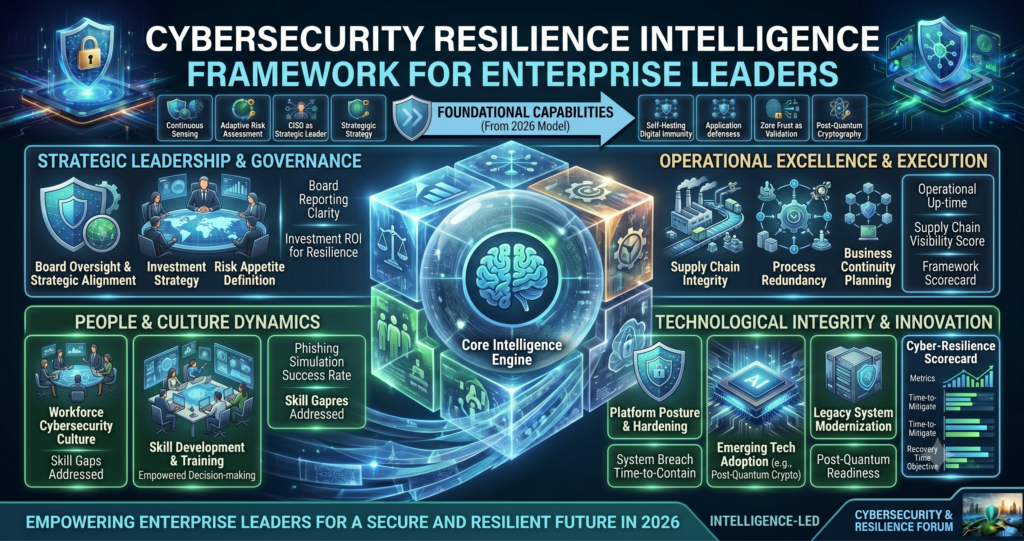
Organizations seeking cyber maturity should align investments around a comprehensive Cybersecurity Resilience Intelligence framework.
Phase 1: Visibility
Understand:
- Assets
- Identities
- Dependencies
- Critical processes
- Threat exposure
You cannot protect what you cannot see.
Phase 2: Intelligence
Establish intelligence-driven decision-making through:
- Threat intelligence feeds
- Risk analytics
- Vulnerability intelligence
- Business impact modeling
This transforms security from reactive defense into proactive strategy.
Phase 3: Adaptation
Implement dynamic controls capable of responding automatically to changing risk conditions.
Examples include:
- Automated access controls
- AI-driven response workflows
- Dynamic segmentation
- Adaptive authentication
Phase 4: Recovery
Develop resilience mechanisms focused on:
- Backup modernization
- Disaster recovery automation
- Operational continuity
- Crisis communication
Recovery speed increasingly determines business impact.
Phase 5: Evolution
Continuously refine:
- Security architecture
- Governance processes
- Incident response capabilities
- Threat detection mechanisms
A mature Cybersecurity Resilience Intelligence framework continuously evolves to address emerging threats and business challenges.
4. Executive Recommendations for 2026 and Beyond
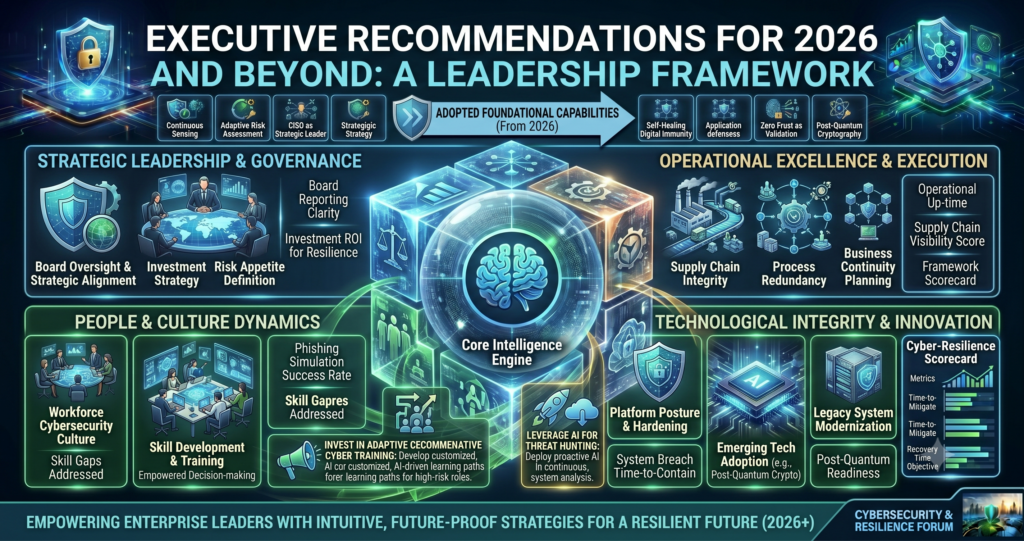
Organizations seeking sustainable cyber resilience should prioritize the following initiatives:
Invest in Security Intelligence Platforms
Consolidate threat intelligence, risk analytics, and operational insights.
Adopt Enterprise-Wide Zero Trust
Identity-centric security should become the default operating model.
Modernize Security Operations
Integrate AI and automation into SOC workflows.
Strengthen Supply Chain Governance
Expand visibility into third-party risk ecosystems.
Build Recovery-First Architectures
Design systems assuming disruption will occur.
Establish Board-Level Cyber Governance
Treat cyber risk as a strategic business risk rather than a technical issue.
Develop Organizational Resilience Metrics
Measure business outcomes, not just security events.
Organizations that invest in Cybersecurity Resilience Intelligence today will be significantly better positioned to withstand future cyber disruptions and maintain long-term business continuity.
Conclusion
Cybersecurity Resilience Intelligence represents the future of enterprise security and resilience. Organizations capable of integrating advanced defense capabilities with Cybersecurity Resilience Intelligence frameworks will be better equipped to manage uncertainty, reduce operational risk, and sustain growth in an increasingly complex threat landscape.
Modern cybersecurity trends demonstrate a clear shift away from prevention-centric models toward intelligence-driven resilience frameworks. AI-powered security, predictive threat intelligence, Zero Trust architectures, cloud-native protection, and cyber resilience governance are no longer emerging concepts they are strategic necessities.
Cybersecurity Resilience Intelligence provides the framework needed to navigate this evolving landscape. By integrating cybersecurity, risk management, operational continuity, and business strategy, organizations can transform uncertainty into a source of competitive advantage.
In the coming decade, the most successful enterprises will not be those that avoid every cyber incident. They will be those that can anticipate disruption, adapt rapidly, recover efficiently, and emerge stronger after every challenge.
Ultimately, Cybersecurity Resilience Intelligence transforms cybersecurity from a technical function into a strategic business capability that drives resilience, innovation, stakeholder trust, and long-term competitive advantage.
Cybersecurity is no longer merely about defending systems.
It is about safeguarding the future of the business itself through Cybersecurity Resilience Intelligence.
Also Read Our other Blogs: The Rise of AI Multi-Agent Systems and LLMOps in Data ScienceTransforming the Future in 2026
