
Introduction
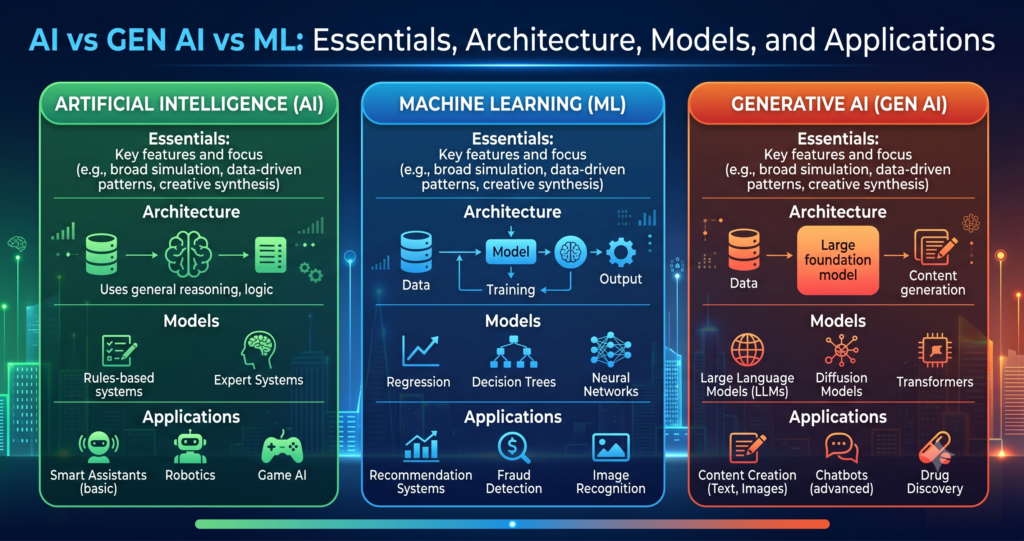
Artificial Intelligence is transforming industries, businesses, and everyday life at an unprecedented pace. However, many professionals, students, and business leaders often use the terms AI vs Gen AI vs ML: Key Differences Artificial Intelligence (AI), Generative AI (Gen AI), and Machine Learning (ML) interchangeably. While these technologies are closely related, they have distinct purposes, architectures, models, and applications.
Understanding AI vs Gen AI vs ML is essential for organizations planning digital transformation, technology investments, and innovation strategies. Each technology serves a unique role in solving business challenges, automating processes, and creating intelligent systems.
This comprehensive guide explores the fundamentals, architectures, models, differences, advantages, and real-world applications of AI, Gen AI, and ML to help you understand where each technology fits in the modern technology landscape.
Table of Contents
Do Checkout: NVIDIA Generative AI Resource center
1. What is Artificial Intelligence (AI)?
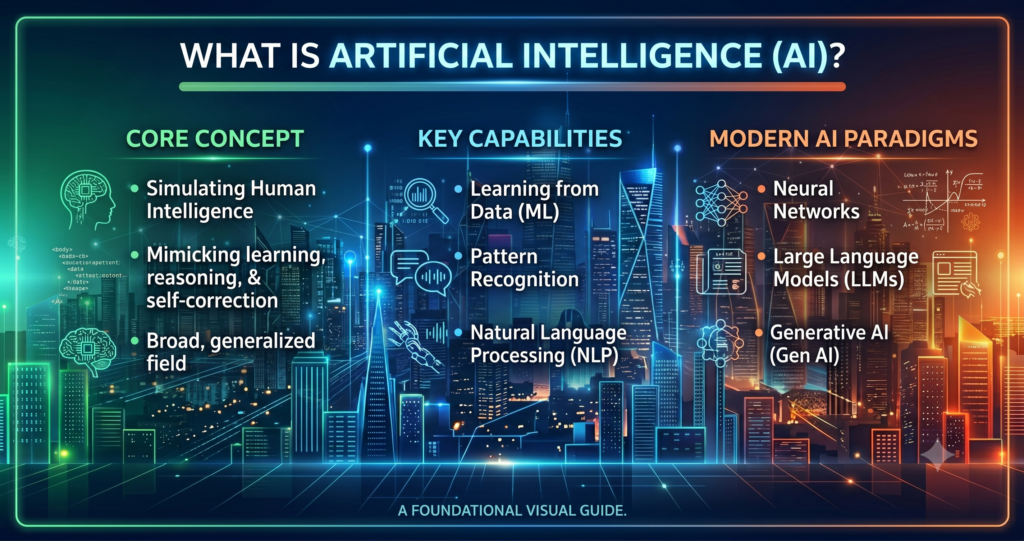
Artificial Intelligence (AI) is the broad field of computer science focused on creating systems capable of performing tasks that typically require human intelligence. These tasks include reasoning, decision-making, learning, perception, language understanding, and problem-solving.
AI aims to mimic human cognitive abilities and improve efficiency through automation and intelligent decision-making.
Core Characteristics of AI
- Problem-solving capabilities
- Decision-making processes
- Pattern recognition
- Natural language understanding
- Knowledge representation
- Automated reasoning
Examples of AI
- Virtual assistants
- Autonomous vehicles
- Fraud detection systems
- Recommendation engines
- Smart home devices
- Robotics
AI acts as the umbrella category under which Machine Learning and Generative AI operate.
2. What is Machine Learning (ML)?
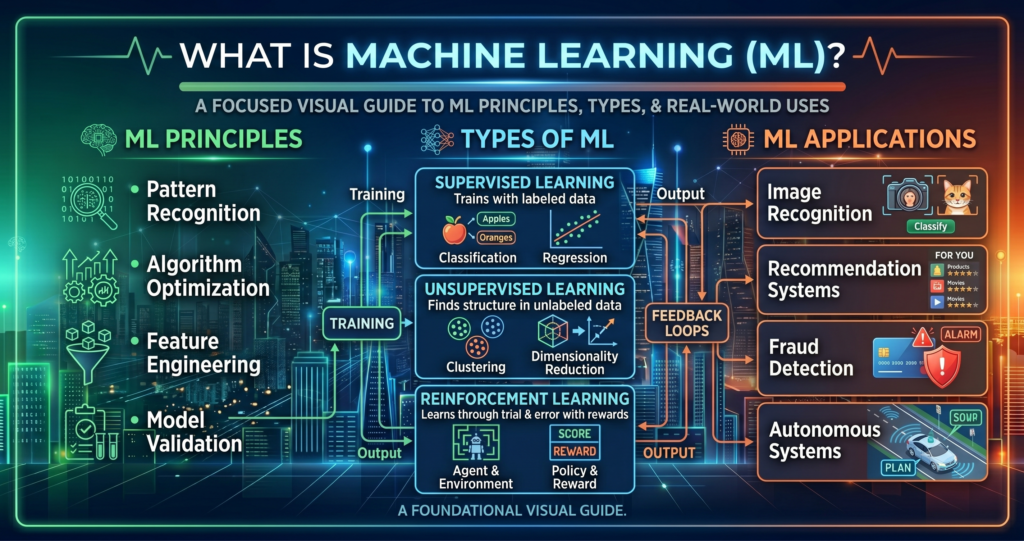
Machine Learning is a subset of AI that enables systems to learn from data without being explicitly programmed for every task.
Instead of following predefined instructions, ML algorithms identify patterns in historical data and make predictions or decisions based on those patterns.
When discussing AI vs Gen AI vs ML, ML serves as the predictive intelligence layer that powers many AI systems.
How Machine Learning Works
Machine Learning follows a structured process:
- Data collection
- Data preprocessing
- Model training
- Pattern learning
- Prediction generation
- Continuous improvement
Types of Machine Learning
Supervised Learning
Uses labeled datasets to train models.
Examples:
- Spam detection
- Customer churn prediction
- Credit risk assessment
Unsupervised Learning
Finds hidden patterns in unlabeled data.
Examples:
- Customer segmentation
- Market basket analysis
- Anomaly detection
Reinforcement Learning
Learns through rewards and penalties.
Examples:
- Robotics
- Self-driving vehicles
- Game-playing AI
Popular ML Models
- Linear Regression
- Logistic Regression
- Decision Trees
- Random Forest
- Support Vector Machines
- Gradient Boosting
- Neural Networks
3. What is Generative AI (Gen AI)?
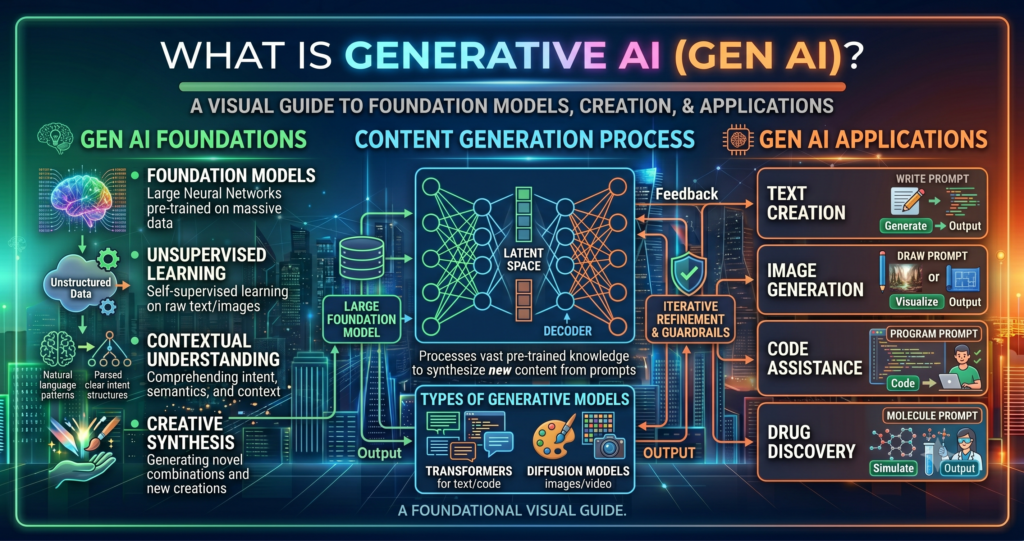
Generative AI is an advanced subset of AI focused on creating new content rather than simply analyzing existing data.
Unlike traditional Machine Learning models that predict outcomes, Gen AI generates text, images, videos, code, audio, and other forms of content.
The rise of Generative AI has significantly changed the conversation around AI vs Gen AI vs ML, as organizations increasingly use AI for content creation and innovation.
Key Capabilities of Generative AI
- Text generation
- Image generation
- Video creation
- Code generation
- Audio synthesis
- Content summarization
Examples of Generative AI
- AI chatbots
- AI image generators
- AI coding assistants
- Video generation tools
- Content creation platforms
Popular Generative AI Models
- Large Language Models (LLMs)
- Generative Adversarial Networks (GANs)
- Diffusion Models
- Transformer Models
- Variational Autoencoders (VAEs)
4. Understanding AI vs Gen AI vs ML
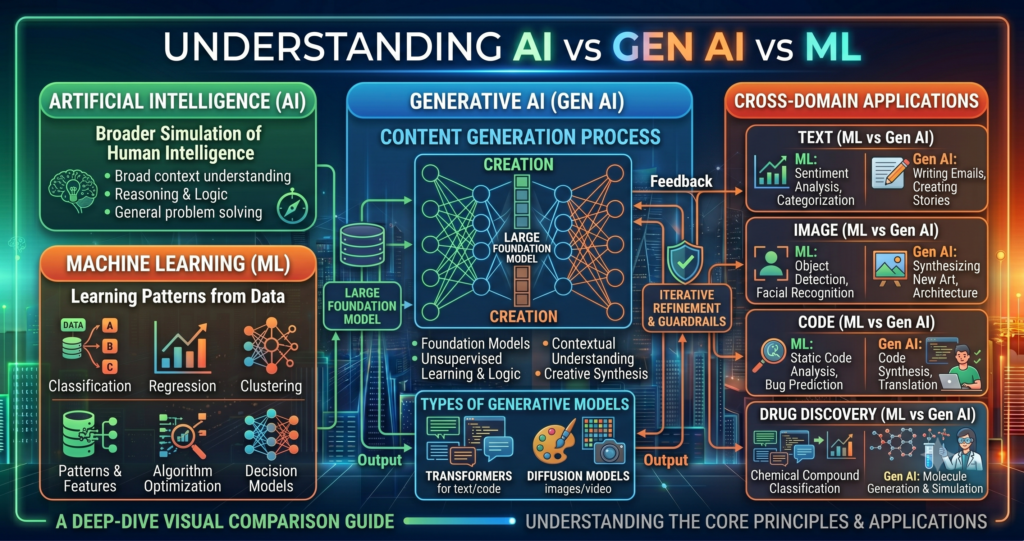
The relationship between AI, ML, and Gen AI can be visualized as a hierarchy:
- AI is the broadest category.
- ML is a subset of AI.
- Gen AI is a specialized subset of AI that often relies on advanced ML techniques.
Technology Scope Comparison
Conceptual comparison of AI, ML, and Generative AI scope.
Technology Scope.
| AI | ML | Gen AI |
| 100 | 60 | 30 |
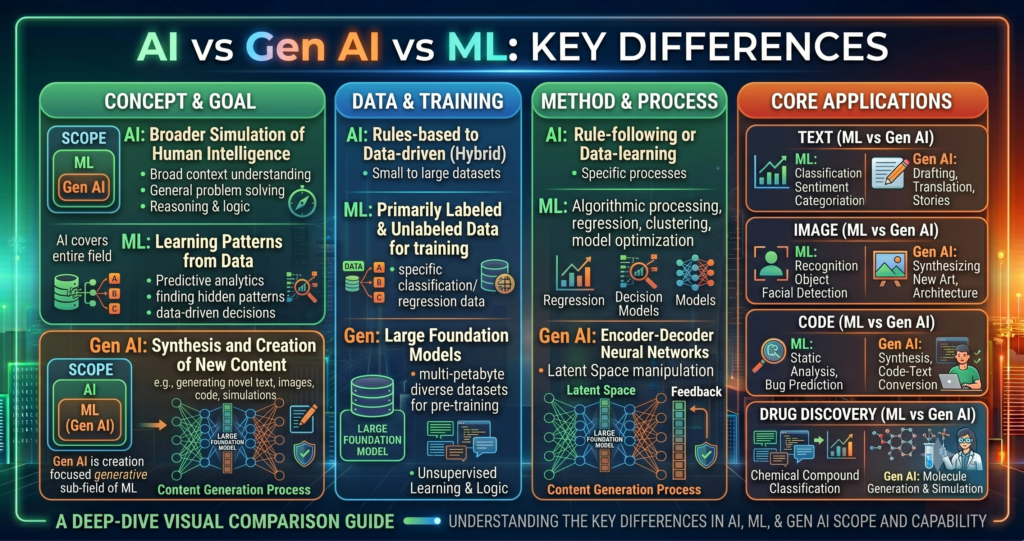
5. AI vs Gen AI vs ML: Key Differences
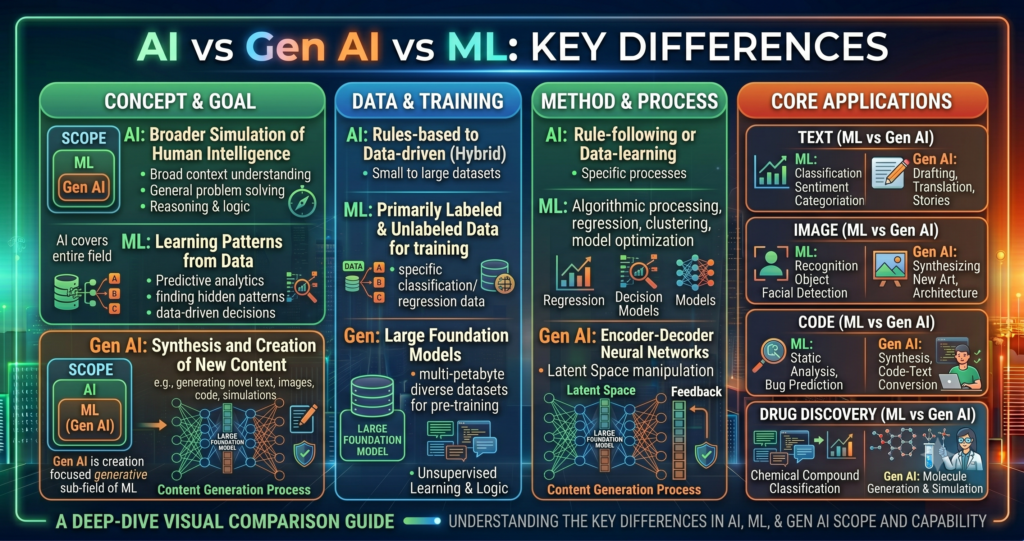
| Feature | AI | ML | Gen AI |
|---|---|---|---|
| Definition | Broad intelligence systems | Data-driven learning systems | Content-generating systems |
| Goal | Simulate intelligence | Learn patterns from data | Create new content |
| Data Usage | Uses rules and learning | Learns from datasets | Learns and generates outputs |
| Output | Decisions and actions | Predictions | New content |
| Human Intervention | Moderate | Low after training | Low after training |
| Complexity | Broad range | Moderate to high | High |
| Examples | Robotics, assistants | Fraud detection | Chatbots, image generators |
Understanding these distinctions is crucial when evaluating AI vs Gen AI vs ML for business applications.
6. Architecture of AI
Traditional AI architecture consists of several layers:
Input Layer
Receives data from users, sensors, databases, or systems.
Knowledge Base
Stores facts, rules, and relationships.
Inference Engine
Processes information and makes decisions.
Output Layer
Delivers recommendations, actions, or responses.
AI Architecture Workflow
Input Data → Knowledge Processing → Decision Logic → Output
This architecture focuses on reasoning and intelligent decision-making.
7. Architecture of Machine Learning
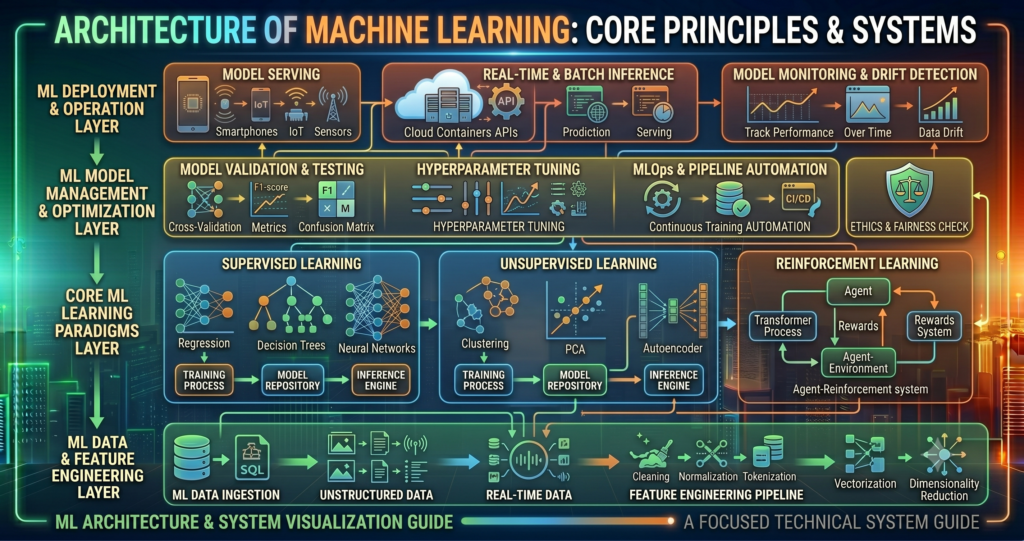
Machine Learning architecture is heavily data-centric.
Components
Data Collection Layer
Collects structured and unstructured data.
Data Processing Layer
Cleans and transforms data.
Model Training Layer
Builds predictive algorithms.
Evaluation Layer
Measures accuracy and performance.
Prediction Layer
Generates outputs based on learned patterns.
ML Architecture Workflow
Data → Feature Engineering → Model Training → Validation → Prediction
This architecture enables ML systems to continuously improve performance through learning.
8. Architecture of Generative AI
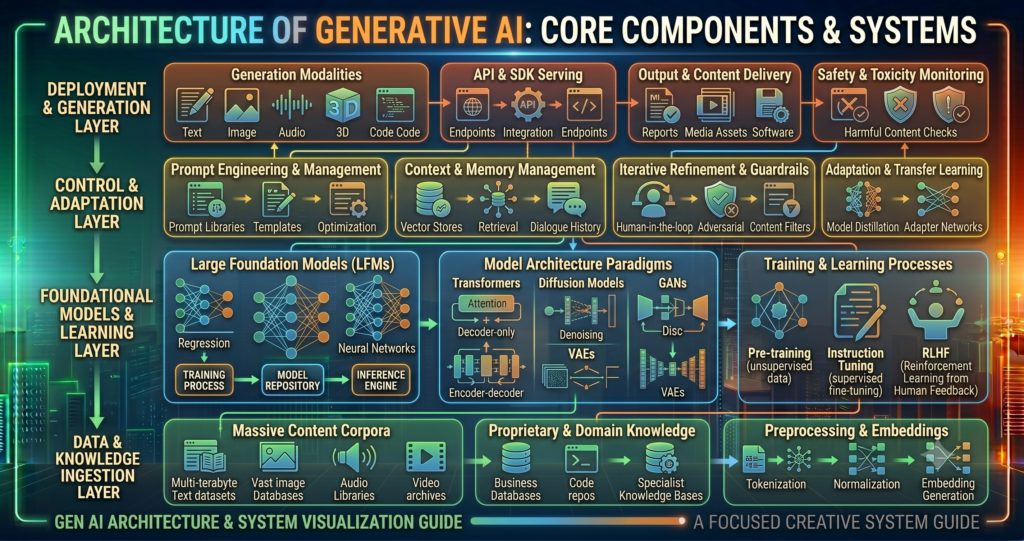
Generative AI architecture is significantly more complex.
Core Components
Massive Training Data
Trains on billions of documents, images, or records.
Foundation Models
Large-scale neural networks capable of understanding context.
Transformer Architecture
Processes relationships between words, images, and data elements.
Generation Engine
Creates new content based on prompts.
Feedback Loop
Improves output quality through optimization.
Gen AI Architecture Workflow
Prompt → Transformer Model → Context Analysis → Content Generation → Output
The sophistication of this architecture makes Generative AI uniquely capable in the AI vs Gen AI vs ML comparison.
9. Models Used in AI
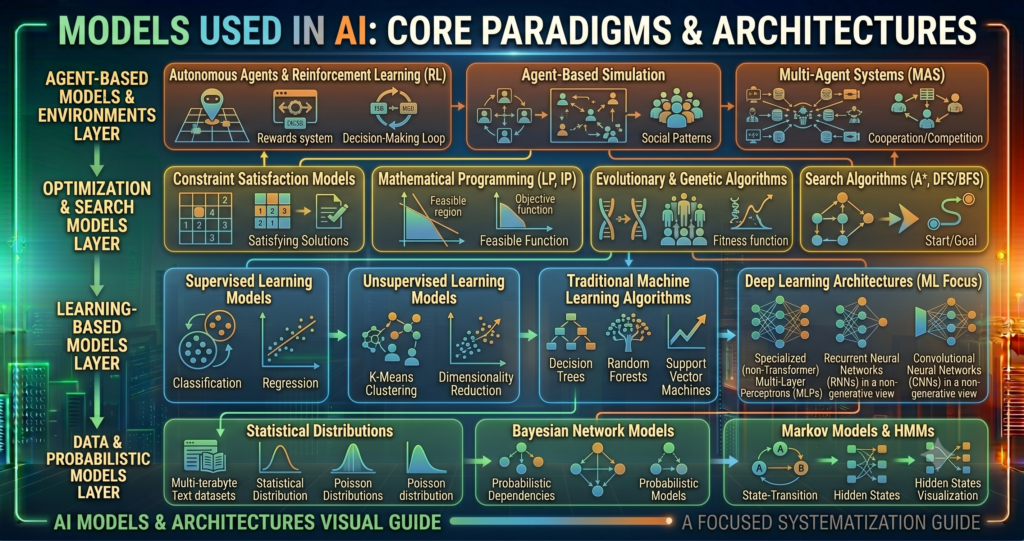
AI encompasses multiple model categories:
Rule-Based Models
Follow predefined instructions.
Examples:
- Expert systems
- Decision support systems
Search Algorithms
Explore possible solutions.
Examples:
- A* Algorithm
- Minimax Algorithm
Knowledge-Based Systems
Use structured information for reasoning.
Examples:
- Medical diagnosis systems
- Legal advisory systems
10. Models Used in Machine Learning
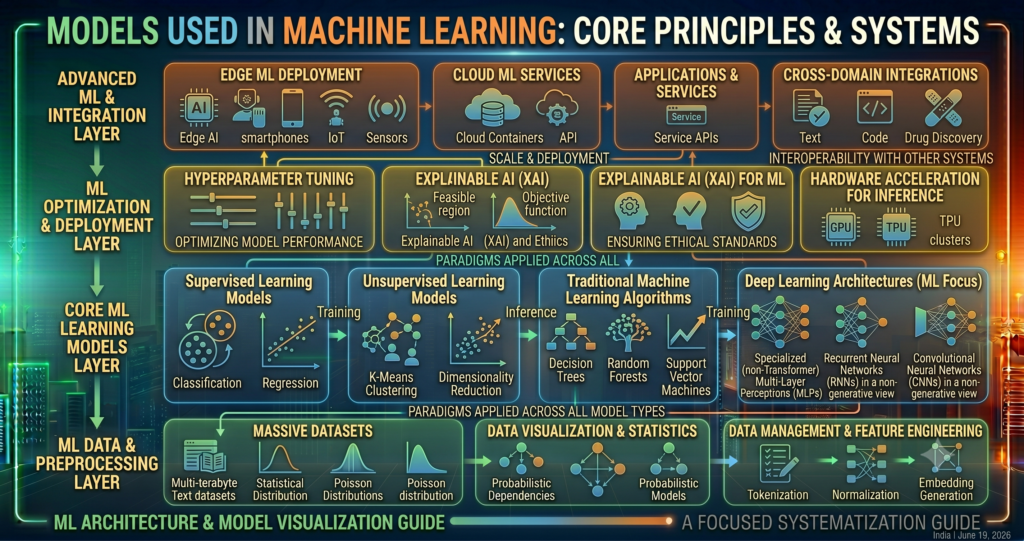
Machine Learning relies on statistical and mathematical models.
Regression Models
Predict numerical values.
Examples:
- House price prediction
- Sales forecasting
Classification Models
Assign categories.
Examples:
- Email filtering
- Risk scoring
Clustering Models
Group similar data points.
Examples:
- Customer segmentation
- Market analysis
Neural Networks
Handle complex pattern recognition tasks.
Examples:
- Image recognition
- Speech processing
11. Models Used in Generative AI
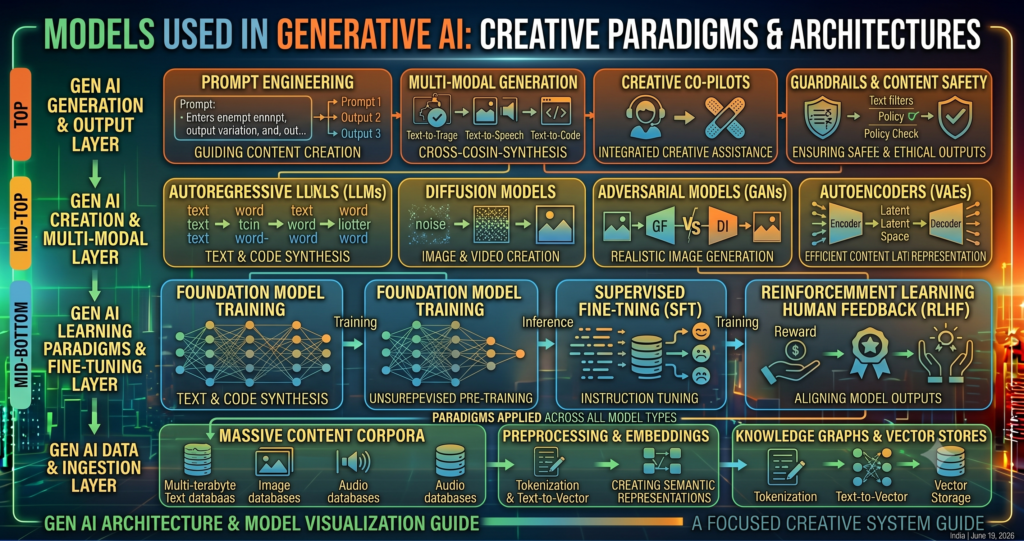
Generative AI uses advanced deep-learning architectures.
Transformer Models
The foundation of modern language models.
Applications:
- Chatbots
- Content creation
- Translation
Generative Adversarial Networks (GANs)
Two neural networks compete to create realistic outputs.
Applications:
- Image generation
- Video creation
Diffusion Models
Generate high-quality visual content.
Applications:
- AI art
- Design generation
Variational Autoencoders (VAEs)
Create new data representations.
Applications:
- Image synthesis
- Data augmentation
12. Business Applications of AI
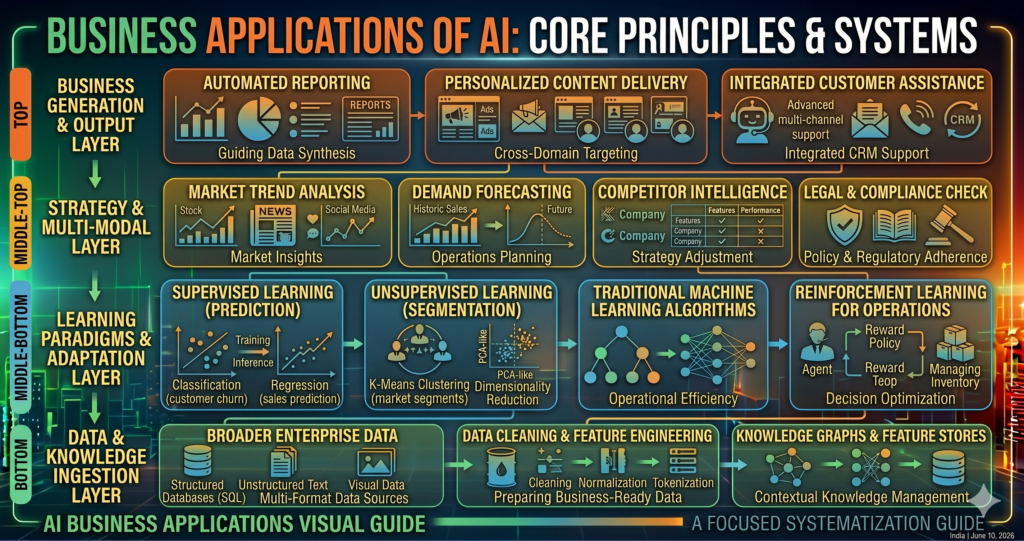
Organizations use AI to improve operational efficiency.
Healthcare
- Disease diagnosis
- Patient monitoring
- Drug discovery
Finance
- Fraud detection
- Risk management
- Automated trading
Manufacturing
- Predictive maintenance
- Quality control
- Robotics
Retail
- Inventory management
- Customer support
- Demand forecasting
13. Business Applications of Machine Learning
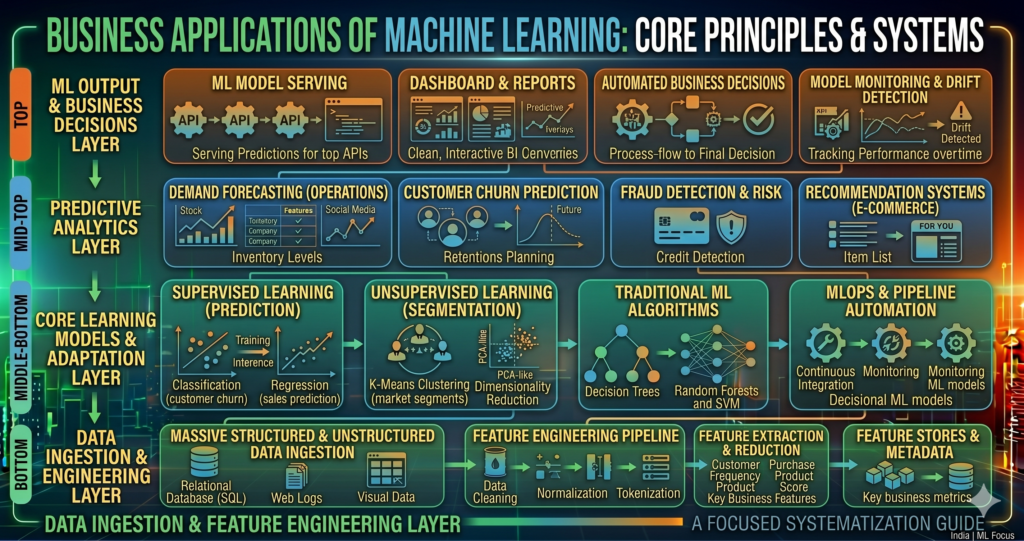
Machine Learning powers predictive intelligence.
Marketing
- Customer segmentation
- Lead scoring
- Campaign optimization
Banking
- Credit scoring
- Fraud analytics
- Customer retention
E-commerce
- Product recommendations
- Dynamic pricing
- Demand prediction
Human Resources
- Resume screening
- Workforce analytics
- Employee retention forecasting
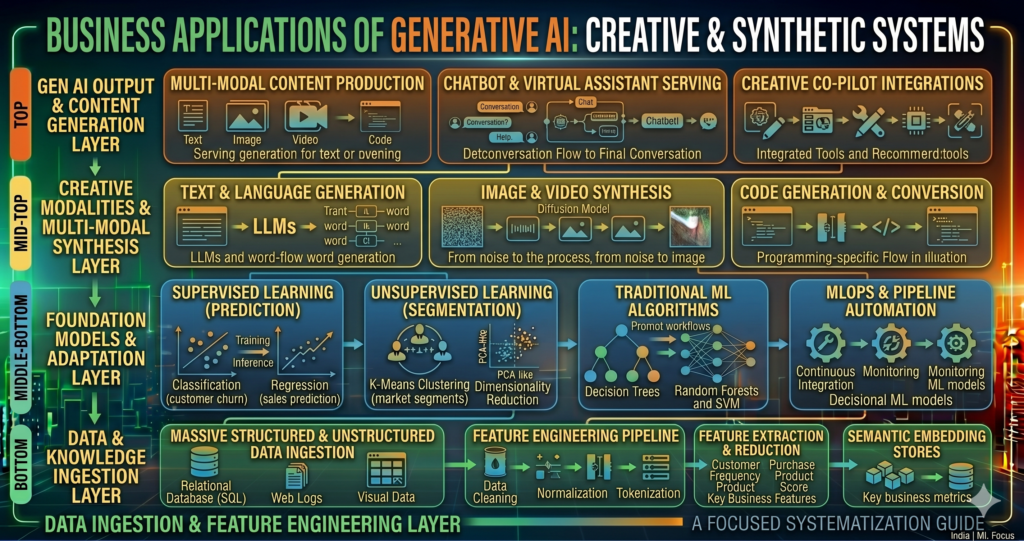
14. Business Applications of Generative AI
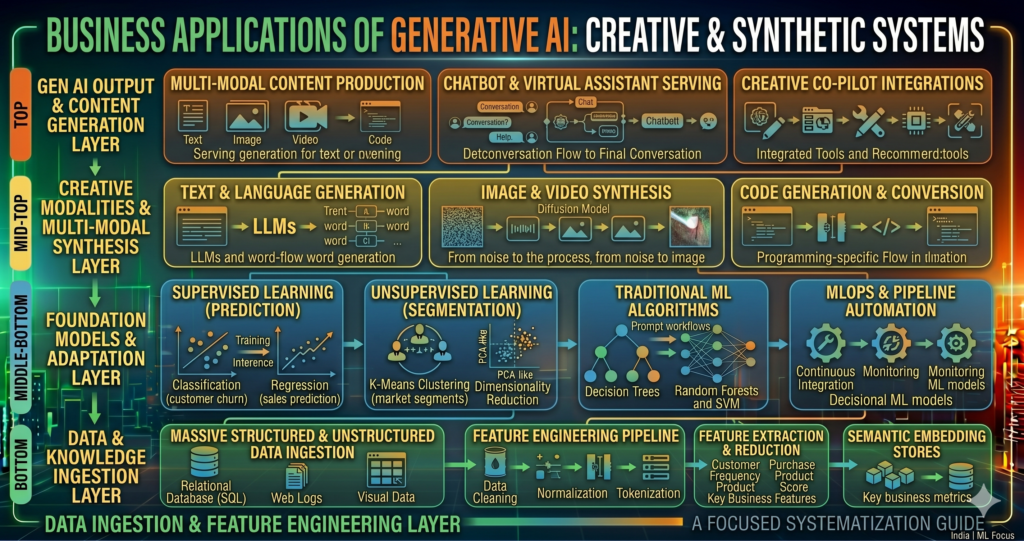
Generative AI is transforming content creation and innovation.
Content Marketing
- Blog writing
- Social media content
- Email campaigns
Software Development
- Code generation
- Testing automation
- Documentation creation
Design and Creativity
- Graphic design
- Logo creation
- Video production
Customer Service
- Intelligent chatbots
- Personalized responses
- Knowledge management
The expanding capabilities of Gen AI continue to reshape the discussion around AI vs Gen AI vs ML across industries.
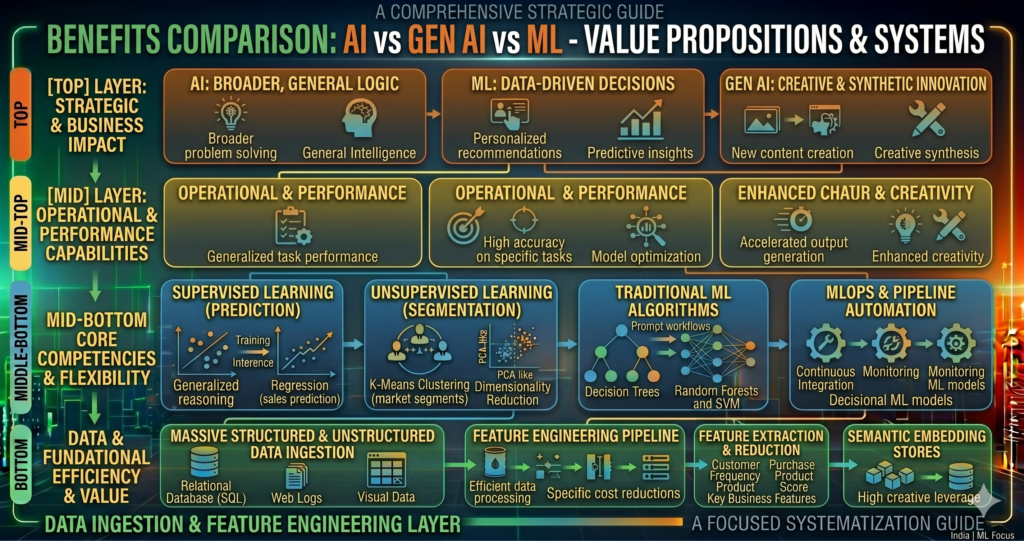
15. Benefits of AI vs Gen AI vs ML
Benefits of AI
- Automation of repetitive tasks
- Improved decision-making
- Increased operational efficiency
- Enhanced customer experiences
Benefits of ML
- Accurate predictions
- Continuous learning
- Scalable analytics
- Data-driven insights
Benefits of Gen AI
- Faster content creation
- Enhanced creativity
- Reduced production costs
- Improved productivity
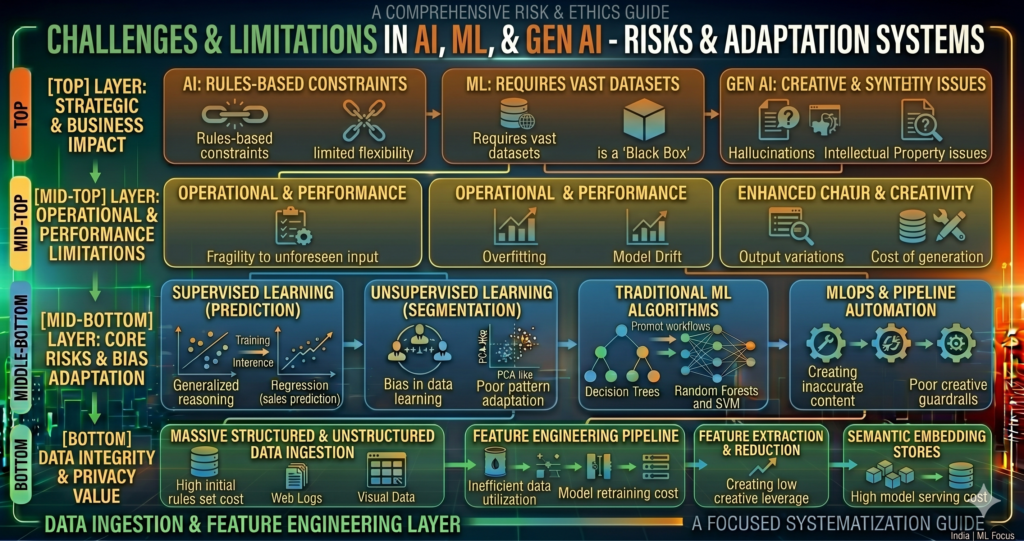
16. Challenges and Limitations
AI Challenges
- High implementation costs
- Ethical concerns
- Complexity of deployment
ML Challenges
- Data dependency
- Model bias
- Feature engineering requirements
Gen AI Challenges
- Hallucinations
- Copyright concerns
- Data privacy risks
- Resource-intensive training
Organizations evaluating AI vs Gen AI vs ML should carefully consider these limitations before implementation.
17. Future Trends
AI vs Gen AI vs ML: Several trends will shape the future of AI technologies:
Multimodal AI
Systems capable of processing text, images, audio, and video simultaneously.
Autonomous Agents
AI systems capable of completing tasks independently.
Explainable AI
Improved transparency in decision-making.
Industry-Specific Models
Customized AI solutions for healthcare, finance, retail, and manufacturing.
Human-AI Collaboration
Greater integration between human expertise and AI-powered systems.
These innovations will further blur the boundaries between AI vs Gen AI vs ML while creating new opportunities for businesses worldwide.
Conclusion
Understanding AI vs Gen AI vs ML is essential for navigating today’s rapidly evolving technology landscape. Artificial Intelligence provides the broad framework for intelligent systems, Machine Learning enables systems to learn from data and make predictions, while Generative AI creates entirely new content and experiences.
Although they share common foundations, each technology serves different objectives. AI focuses on intelligent decision-making, ML specializes in pattern recognition and prediction, and Gen AI excels at content generation and creative problem-solving.
Businesses that understand the differences between AI vs Gen AI vs ML can make better technology decisions, improve operational efficiency, enhance customer experiences, and unlock new opportunities for innovation. As these technologies continue to evolve, their combined impact will drive the next generation of digital transformation across industries.
Also Read Our other Blogs: How to Grow Your Lifestyle Presence and Stay Active in Everyday Living
