Table of Contents
Marketing is changing faster than ever. Customers expect relevant content, quick responses, and personalised experiences. At the same time, businesses need to manage advertising costs, generate quality leads, and improve conversions.
Traditional marketing methods alone may not meet these expectations. This is where artificial intelligence (AI) is changing the way brands attract, engage, and retain customers.
In 2026, businesses are using AI to understand customer behaviour, automate repetitive tasks, analyse campaign performance and make smarter marketing decisions. The right AI marketing strategies can help brands save time, reach the right audience and create better customer experiences.
According to Salesforce’s 2026 State of Marketing research, 81% of marketers in India have adopted AI. However, the report also highlights the importance of unified customer data for effective engagement.
This shows that adopting AI is only the first step. Businesses need a clear strategy to turn technology into measurable growth.
In this blog, we explore five powerful AI marketing strategies that can help businesses improve their marketing performance, build stronger customer relationships, and grow their brands in 2026.
What Is AI Marketing?
AI marketing is the use of artificial intelligence technologies to plan, execute, analyse, and improve marketing activities. It uses technologies such as machine learning, natural language processing, predictive models, and generative AI to support marketing decisions.
These technologies help businesses understand customer interests, identify potential buyers, create content and automate communication.
For example, an e-commerce business can use AI to recommend products based on a customer’s browsing history. A digital marketing agency can analyse campaign data to identify which advertisements generate quality leads.
AI does not replace the need for marketing knowledge or creativity. Instead, it helps marketers make informed decisions and complete tasks more efficiently.
Some common applications include:
- Automated email marketing and customer follow-ups.
- AI-based content creation and optimisation.
- Customer behaviour analysis.
- Predictive sales and lead scoring.
- Personalised product recommendations.
- AI-powered chatbots and customer support.
- Advertising audience optimisation.
When these applications work together, businesses can build more effective marketing systems.
Why Are AI Marketing Strategies Important in 2026?
The digital marketing landscape is becoming more competitive. Customers interact with brands through search engines, social media, websites, email, and messaging platforms.
Managing these channels manually can consume time and resources. AI helps businesses process information faster and respond to changing customer needs.
Here are some reasons why AI adoption matters in 2026.
1. Better customer understanding: AI can analyse customer interactions and identify patterns that may be difficult to notice manually.
2. Faster marketing execution: Marketers can use AI to research topics, prepare content, analyse reports, and automate routine tasks.
3. Improved personalisation: Businesses can deliver more relevant messages, offers, and recommendations based on customer interests.
4. Smarter advertising decisions: AI can help identify audience patterns, estimate campaign performance,e and improve budget allocation.
5. Better customer engagement: Conversational systems can provide quick responses and guide customers towards suitable products or services.
The real advantage comes from connecting these capabilities to a strong marketing foundation rather than using separate tools without a clear objective.
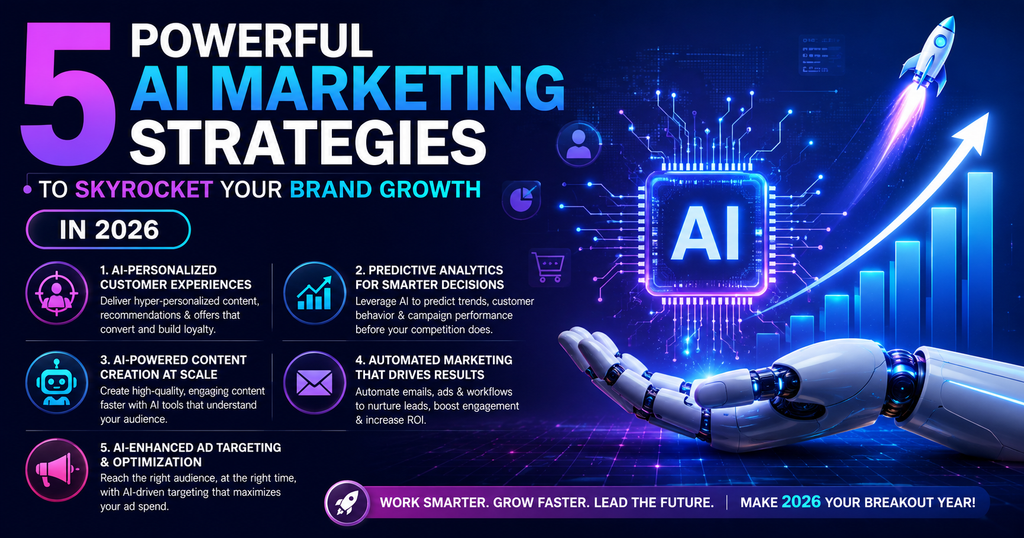
5 Powerful AI Marketing Strategies to Skyrocket Your Brand Growth in 2026
Let’s explore five practical strategies that businesses can use to improve their digital marketing performance.
1. Predictive Analytics: Understand Customer Behaviour Before It Happens
One of the most valuable AI applications in marketing is predictive analytics.
Predictive analytics uses historical data, statistical models,ls and machine learning to estimate what customers may do in the future.
Instead of making decisions based only on past performance, businesses can use available data to identify possible future trends.
For example, an online fashion store can analyse previous purchases, product views and seasonal demand to estimate which products may become popular in the coming weeks.
This helps the business plan inventory, prepare promotions and allocate advertising budgets more effectively.
How Does Predictive Analytics Work?
AI systems collect and analyse information from different sources, including:
- Website traffic and browsing behaviour.
- Previous purchases and transaction history.
- Email engagement and customer responses.
- Social media interactions.
- Advertising campaign performance.
- Customer relationship management (CRM) data.
The system identifies patterns and uses them to generate predictions or recommendations.
Practical Applications of Predictive Analytics
1. Predict customer purchases
AI can identify customers who show strong buying signals based on their previous interactions. Marketing teams can use these insights to create relevant offers.
2. Identify customers at risk of leaving
Businesses can analyse declining engagement, reduced purchase frequency, and customer complaints to identify possible churn.
3. Improve campaign planning
Predictive models can estimate potential campaign outcomes and help marketers compare different targeting or budget options.
4. Improve lead scoring
AI can evaluate lead behaviour, form submissions and previous interactions to help sales teams prioritise promising prospects.
Recommended AI Marketing Tools
- Google Analytics 4 – For website behaviour and audience insights.
- HubSpot – For CRM data, lead management and marketing automation.
- Microsoft Power BI – For analysing marketing data and creating dashboards.
- Salesforce Einstein – For AI-powered CRM insights and predictions.
Real-World Example
Imagine a Chennai-based real estate company running digital advertisements for residential plots.
Instead of targeting everyone in the city, the company can analyse website visits, enquiry forms, previous lead interactions, and campaign performance.
Predictive models can help identify which leads are more likely to enquire or convert. The marketing team can then prioritise follow-ups and improve campaign planning.
Business benefit: Better lead prioritisation, smarter budget decisions and more efficient customer acquisition.
2. Precision Targeting: Reach the Right Audience at the Right Time
Reaching a large audience does not always mean generating more business. A campaign may receive thousands of impressions but produce very few quality leads.
This is why precision targeting is an important part of modern marketing.
Precision targeting uses customer data, behavioural insights and AI-powered analysis to identify audiences that are more likely to engage with a brand.
Rather than showing the same advertisement to everyone, businesses can create campaigns based on customer interests, location, demographics and purchase intent.
How AI Improves Audience Targeting
AI systems can analyse several types of customer information to identify useful audience patterns.
These include:
- Age groups and geographic locations.
- Search and browsing behaviour.
- Previous purchases.
- Product interests.
- Website engagement.
- Content preferences.
- Customer interaction history.
Marketers can use these insights to develop more relevant campaigns.
Four Ways to Apply Precision Targeting
1. Behavioural targeting
Understand what customers do online. For example, an online electronics store can identify visitors who repeatedly view laptops but do not complete a purchase.
2. Location-based targeting
Deliver relevant promotions to customers in specific locations. A Chennai restaurant can promote lunch offers to nearby audiences instead of targeting users across India.
3. Interest-based targeting
Create audience groups based on relevant interests and content engagement.
4. Intent-based targeting
Identify users who demonstrate buying interest through searches, enquirie,s or repeated product interactions.
Recommended AI Marketing Tools
- Meta Ads Advantage+ – For automated campaign optimisation and audience delivery.
- Google Ads Performance Max – For AI-assisted advertising across Google’s eligible channels.
- Google Analytics 4 – For understanding audience behaviour.
- Semrush – For keyword research, competitor analysis and search insights.
Real-World Example
Consider a dermatology clinic in Chennai that wants to promote its skin consultation services.
A broad advertising campaign may attract people who are not looking for dermatology services.
Instead, the clinic can develop location-relevant campaigns, create educational content around skin concerns,ns and use suitable audience signals within advertising platforms.
The campaign can then be evaluated using enquiry quality, appointment bookings, and conversion rates.
Business benefit: More relevant audience reach, less wasted advertising spen,d and better lead quality.
Important: Healthcare advertising must follow platform policies and applicable privacy requirements. Avoid targeting based on sensitive personal health information.
3. Conversational Marketing: Turn Customer Conversations into Conversions
Customers do not always want to fill out long forms or wait for a sales representative to respond.
They expect businesses to answer questions quickly and provide useful information throughout their buying journey.
This is where conversational marketing becomes important.
Conversational marketing uses chatbots, messaging platforms,ms and AI-powered assistants to communicate with customers in a natural and interactive way.
Unlike traditional one-way marketing, it creates opportunities for customers to ask questions, explore produ,cts and receive personalised assistance.
How AI-Powered Conversational Marketing Works
AI-powered chat systems use natural language processing and language models to understand customer questions and generate relevant responses.
For example, a customer visiting a digital marketing agency’s website may ask:
- What digital marketing services do you offer?
- How much does SEO cost?
- Do you provide Google Ads management?
- How can I schedule a consultation?
An AI chatbot can answer common questions, collect enquiry details, and direct qualified leads to the sales team.
Four Ways Businesses Can Use Conversational Marketing
1. Website chatbots
Add an AI chatbot to your website to answer frequently asked questions and guide visitors towards relevant services.
2. WhatsApp automation
Use approved WhatsApp Business Platform integrations to send enquiry confirmations, appointment reminders, and relevant updates.
3. AI-powered customer support
Automate responses to common questions and allow human support teams to handle complex issues.
4. Lead qualification
Ask visitors relevant questions about their requirements, budge,t and business goals before forwarding enquiries to the sales team.
Recommended AI Marketing Tools
- Tidio – For website chatbots and customer communication.
- Intercom – For AI-assisted customer support and engagement.
- Manychat – For Instagram, Messenger and WhatsApp automation, subject to channel availability.
- HubSpot – For connecting customer conversations with CRM and sales workflows.
Real-World Example
Imagine a digital marketing training institute receiving enquiries from students through its website and Instagram page.
Students may ask about course fees, duration, placement support, class timings,gs and practical training.
An AI-powered chatbot can answer approved FAQs, share course informat,ion and collect contact details.
Interested students can then be connected with a counsellor for detailed guidance.
This reduces response delays and helps the admissions team manage enquiries more efficiently.
Business benefit: Faster responses, improved lead management and better customer experiences.
4. AI-Powered Content Marketing: Create Relevant Content at Scale
Content marketing remains an important part of brand growth. However, consistently producing useful content for websites, blogs, social media and email campaigns requires time and planning.
AI-powered digital marketing makes content research, creation, and optimisation more efficient.
Generative AI can help marketers develop content ideas, prepare outlines, write initial drafts, generate visuals and repurpose existing content for different platforms.
However, publishing large amounts of automatically generated content is not a successful strategy by itself. Quality, originality, accuracy, and audience relevance still matter.
How to Use AI for Content Marketing
1. AI-powered keyword research
Use research tools to identify relevant search terms, content gaps and questions that customers frequently ask.
2. AI-assisted blog writing
Use AI to prepare blog outlines, organise information and develop first drafts. Add expert knowledge, examples and original insights before publishing.
3. Social media content creation
Generate post ideas, captions, content calendars and creative concepts based on your brand’s audience.
4. Video and creative production
Use AI-assisted tools to generate visual concepts, subtitles, voiceovers, and short-form video edits.
5. Content repurposing
Convert one detailed blog into multiple formats, such as Instagram carousels, LinkedIn posts, short videos,s and email newsletters.
Recommended AI Marketing Tools
| Tool | Main purpose |
|---|---|
| ChatGPT | Research assistance, content ideas and drafting |
| Google Gemini | Research support and content assistance |
| Canva AI | Social media designs and visual content |
| Adobe Firefly | AI-assisted image creation and editing |
| CapCut | Video editing and AI-assisted video features |
| Semrush | SEO research and content optimisation |
Real-World Example
A digital marketing agency wants to promote its SEO services.
The marketing team can use AI to research customer questions, identify relevant keyword,s and prepare a monthly content calendar.
One detailed blog about local SEO can be converted into:
- Five Instagram carousel posts.
- Three short educational Reels.
- Two LinkedIn posts.
- One email newsletter.
- A frequently asked questions section.
A human editor can then review every asset for accuracy, brand voice,ce and usefulness.
This approach helps the business maintain a consistent content schedule without creating every asset from scratch.
Business benefit: Faster content production, consistent brand communication, and better use of existing content.
5. AI Marketing Automation: Build Smarter Customer Journeys
Marketing automation helps businesses manage repetitive marketing activities without performing every task manually.
When combined with artificial intelligence, automation can become more responsive and data-driven.
Instead of sending the same message to every customer, businesses can create workflows based on customer actions, interests, and engagement.
For example, when someone downloads an e-book from a website, an automated system can send a welcome email, share related resource,s and notify the sales team when the person shows further interest.
How AI Improves Marketing Automation
AI can support marketing workflows through:
- Automated email personalisation.
- Lead scoring and prioritisation.
- Customer segmentation.
- Campaign performance analysis.
- Automated follow-up recommendations.
- Customer journey optimisation.
- Behaviour-based communication.
These capabilities help businesses manage customer interactions across different stages of the buying journey.
Four Practical Marketing Automation Strategies
1. Automated email campaigns
Send relevant emails based on customer actions, such as registrations, purchases, downloads,ds or abandoned carts.
2. Lead nurturing
Create a series of useful messages that educate potential customers and guide them towards a purchase decision.
3. Customer retention
Use purchase and engagement patterns to identify customers who may need a reminder, special offer, or additional support.
4. Campaign optimisation
Analyse campaign performance and use available recommendations to improve messaging, timing, and audience selection.
Recommended AI Marketing Tools
- HubSpot Marketing Hub – For CRM, lead nurturing and automation.
- Mailchimp – For email campaigns and marketing automation.
- ActiveCampaign – For customer journeys and email automation.
- Salesforce Marketing Cloud – For enterprise-level customer engagement.
- Zapier – For connecting applications and automating workflows.
Real-World Example
An e-commerce brand receives hundreds of website visits every day but struggles to convert visitors into paying customers.
The business can create an automated journey:
- A visitor browses a product.
- The visitor adds it to the shopping cart.
- The customer leaves without completing the purchase.
- The automation system triggers an eligible reminder.
- The customer returns and completes the purchase.
- After the order, the business sends a confirmation and relevant product information.
AI can help analyse customer behaviour and improve the timing or relevance of these communications.
Business benefit: Less manual work, better customer follow-ups, and improved opportunities for repeat purchases.
How to Build a Strong Marketing Foundation Before Implementing AI
Even the best AI tools cannot fix a poorly planned marketing strategy.
Before implementing AI marketing strategies, businesses need a clear marketing foundation. This means understanding their customers, defining business goal,s and building reliable data systems.
Here are six important steps.
1. Define Your Marketing Goals
Decide what you want to achieve. Your goals may include increasing website traffic, generating leads, improving sales, or retaining existing customers.
2. Understand Your Target Audience
Identify your ideal customers, their problems, interests, buying behaviour, and preferred communication channels.
3. Build a Strong Digital Presence
Create a professional website, optimise your social media profiles and develop useful content that answers customer questions.
4. Organise Your Marketing Data
Connect relevant information from your website, advertising platforms, CRM and email marketing systems. Maintain accurate and consistent data.
5. Select the Right AI Marketing Tools
Do not subscribe to every available tool. Choose platforms based on your business requirements, team size, and budget.
6. Measure Performance Regularly
Track important marketing metrics, compare results,s and improve your campaigns based on reliable data.
A strong marketing foundation allows AI to support better decisions rather than create more confusion.
How to Measure the Success of AI Marketing Strategies
Using AI does not automatically mean that your marketing campaigns are successful.
Businesses need to measure actual results and compare them with their original goals.
Here are some important metrics to track.
| Marketing objective | Key performance indicators |
|---|---|
| Brand awareness | Reach, impressions and brand searches |
| Website growth | Organic traffic, engagement and conversions |
| Lead generation | Leads, cost per lead and lead quality |
| Advertising performance | CTR, CPC, CPA and ROAS |
| Customer engagement | Response time, engagement and email clicks |
| Sales growth | Conversion rate, revenue and customer lifetime value |
| Customer retention | Repeat purchases and churn rate |
For example, if an AI-powered advertising campaign generates more leads but the sales team cannot convert them, increasing the advertising budget may not solve the problem.
Businesses should evaluate the complete customer journey before making decisions.
Common Mistakes to Avoid When Using AI in Marketing
Although AI offers many benefits, incorrect implementation can damage marketing performance.
Avoid these common mistakes.
1. Depending completely on AI-generated content
AI-generated information can contain errors, outdated details, and generic statements. Always review content before publishing.
2. Ignoring customer privacy
Use customer data responsibly. Follow applicable privacy laws, consent requirements,s and platform policies.
3. Using too many tools
Multiple disconnected platforms can create confusion and increase costs. Select tools that work well together.
4. Ignoring human creativity
AI can generate content quickly, but it cannot replace every aspect of human judgement, cultural understanding and original brand storytelling.
5. Measuring activity instead of business results
More posts, emai,ls and impressions do not always mean more revenue. Focus on conversions, customer satisfaction,ion and return on investment.
Frequently Asked Questions (FAQs)
1. What are AI marketing strategies?
AI marketing strategies are approaches that use artificial intelligence to improve marketing activities. They include predictive analytics, precision targeting, conversational marketing, content creation, and marketing automation.
2. How can AI help businesses grow in 2026?
AI can help businesses understand customer behaviour, automate repetitive tasks, personalise campaign,s and improve marketing decisions. It can also help teams identify opportunities and manage customer interactions more efficiently.
3. What are the best AI marketing tools for beginners?
ChatGPT, Google Gemini, Canva AI, Google Analytics 4 and Mailchimp are useful starting points. The best choice depends on whether you need content creation, analytics, design,gn or marketing automation.
4. How does predictive analytics improve digital marketing?
Predictive analytics uses historical and current data to estimate customer behaviour and future trends. It helps marketers prioritise leads, plan campaigns, and make better budget decisions.
5. What is precision targeting in AI marketing?
Precision targeting uses customer data and behavioural insights to reach audiences who are more likely to be interested in a product or service. It helps businesses deliver more relevant advertisements and marketing messages.
6. How does conversational marketing improve customer engagement?
Conversational marketing allows customers to interact with brands through chatbots, messaging platforms, and AI assistants. It helps businesses respond quickly, answer common questions,s and guide customers through their buying journey.
7. Can small businesses use AI marketing strategies?
Yes. Small businesses can start with affordable AI tools for content creation, email marketing, customer support, and analytics. They should begin with one clear business objective instead of investing in several platforms at once.
8. Will AI replace digital marketing professionals?
AI is more likely to change marketing roles than eliminate the need for marketing professionals. Strategy, creativity, customer understanding, communicatio,n and critical thinking remain important skills.
9. How much does AI-powered digital marketing cost?
The cost depends on the tools, subscriptions, integrations,ns and level of automation required. Businesses can begin with free or low-cost tools and expand their investment as they identify measurable benefits.
10. What is the future of AI marketing?
The future of marketing will involve more advanced personalisation, predictive insights, conversational experien,ces and AI-assisted automation. Businesses that combine these technologies with strong strategy and human oversight will be better prepared for changing customer expectations.
Conclusion: Make AI Your Growth Partner in 2026
AI is changing how businesses plan campaigns, understand customers, and build relationships. However, successful marketing is not about using the largest number of AI tools. It is about using the right technology to solve real business problems.
The five AI marketing strategies discussed in this blog offer a practical starting point for businesses looking to improve their marketing performance.
Predictive analytics helps businesses understand future customer behaviour. Precision targeting improves audience relevance. Conversational marketing creates better customer interactions. AI-powered content marketing supports consistent communication, while marketing automation improves the customer journey.
Start with a clear marketing foundation, select tools that match your business goals, and measure results regularly.
Remember, AI can improve the speed and quality of marketing decisions, but your brand still needs a clear identi ty,useful contentn,t and genuine customer relationships.
The brands that succeed in 2026 will not simply use AI. They will use it strategically to create better customer experiences and sustainable business growth.